Case Study: Are Type 2 Diabetes and Alzheimer's Disease Genetically Connected?
The question: Type 2 Diabetes and Alzheimer's disease show up together in patients more often than chance would predict. Some researchers even call Alzheimer's "type 3 diabetes," because brain insulin resistance looks so much like the peripheral kind. Is there an actual genetic basis for that connection sitting inside GeDiPNet's curated data — and if so, could it point to a shared drug target? Rather than explain GeDiPNet's pages one at a time, this post chases that one question through Browse and every type of analysis, in order, using real searches and real results.
Browse: genes, diseases, and pathways
Before running any analysis, a few minutes of browsing already turns up a real signal.
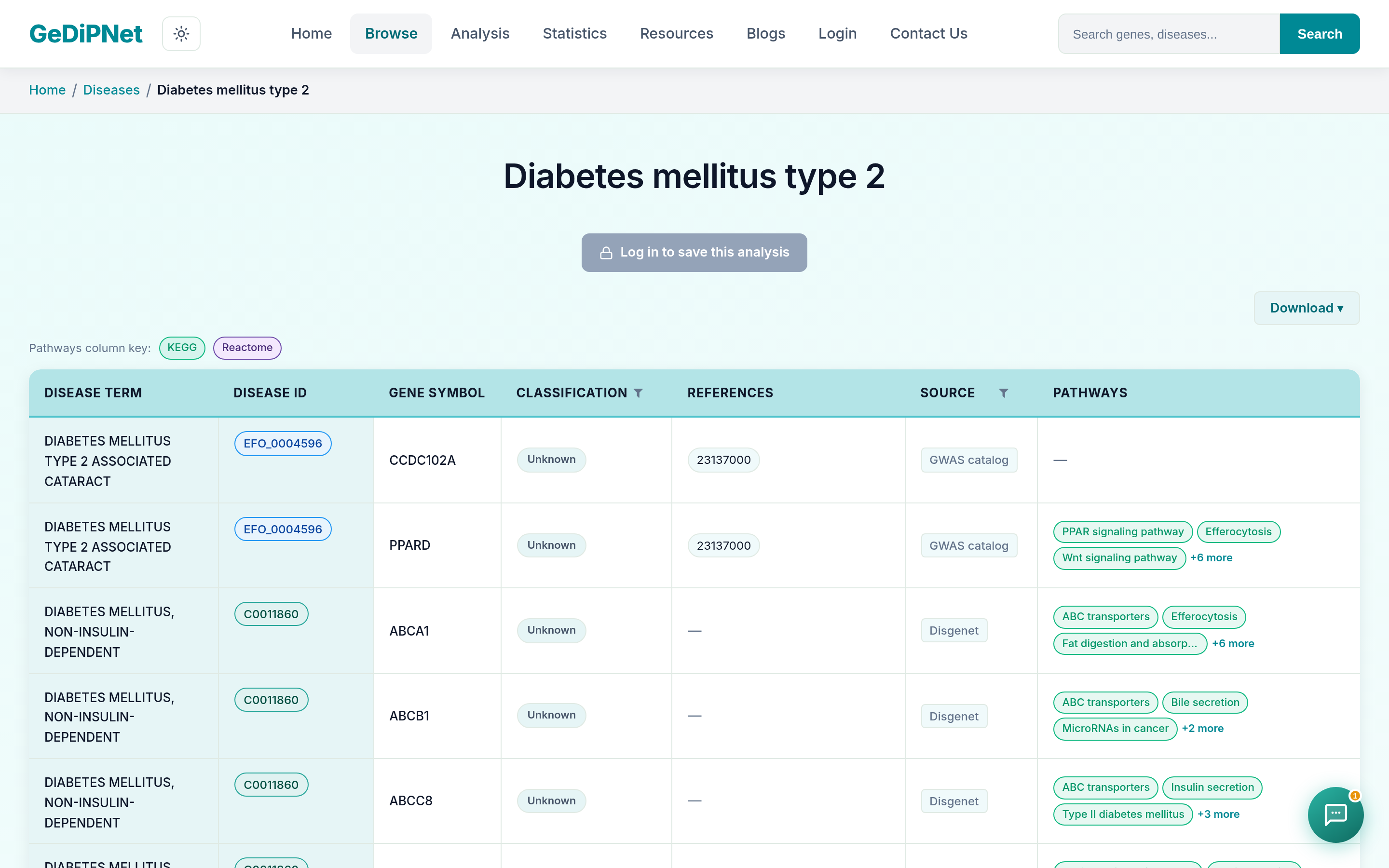
Browse Diseases
Searching Browse > Diseases for "Type 2 Diabetes" brings up Diabetes mellitus type 2 — curated in GeDiPNet from over 3,000 gene associations, including TCF7L2, INSR, GCK, HNF1A, HNF4A, and KCNJ11.
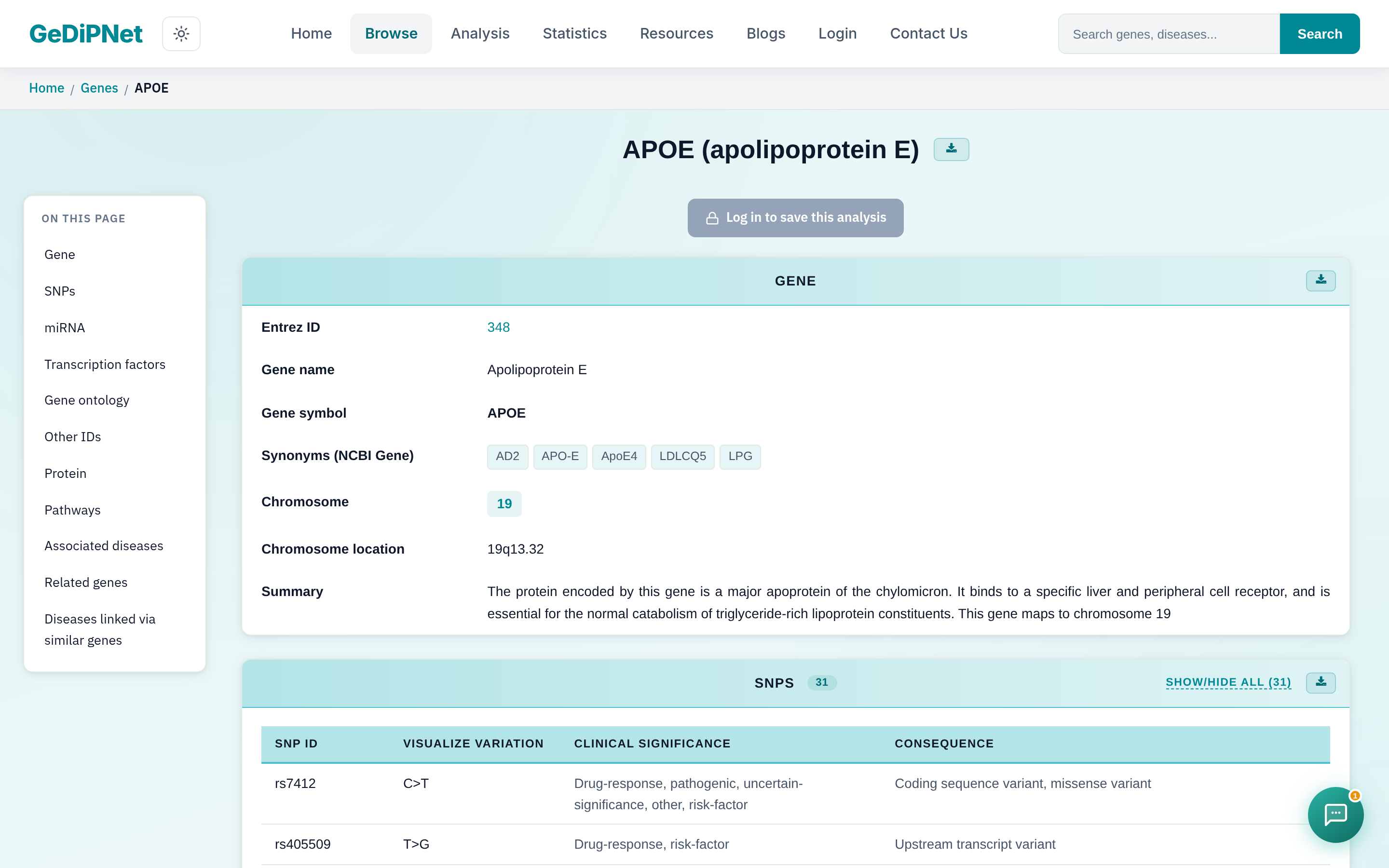
Browse Genes
Doing the same for "Alzheimer's" brings up Alzheimer disease, and opening the gene page for APOE — GeDiPNet's most-cited Alzheimer's gene — shows it's also listed against diabetes-related disease entries.
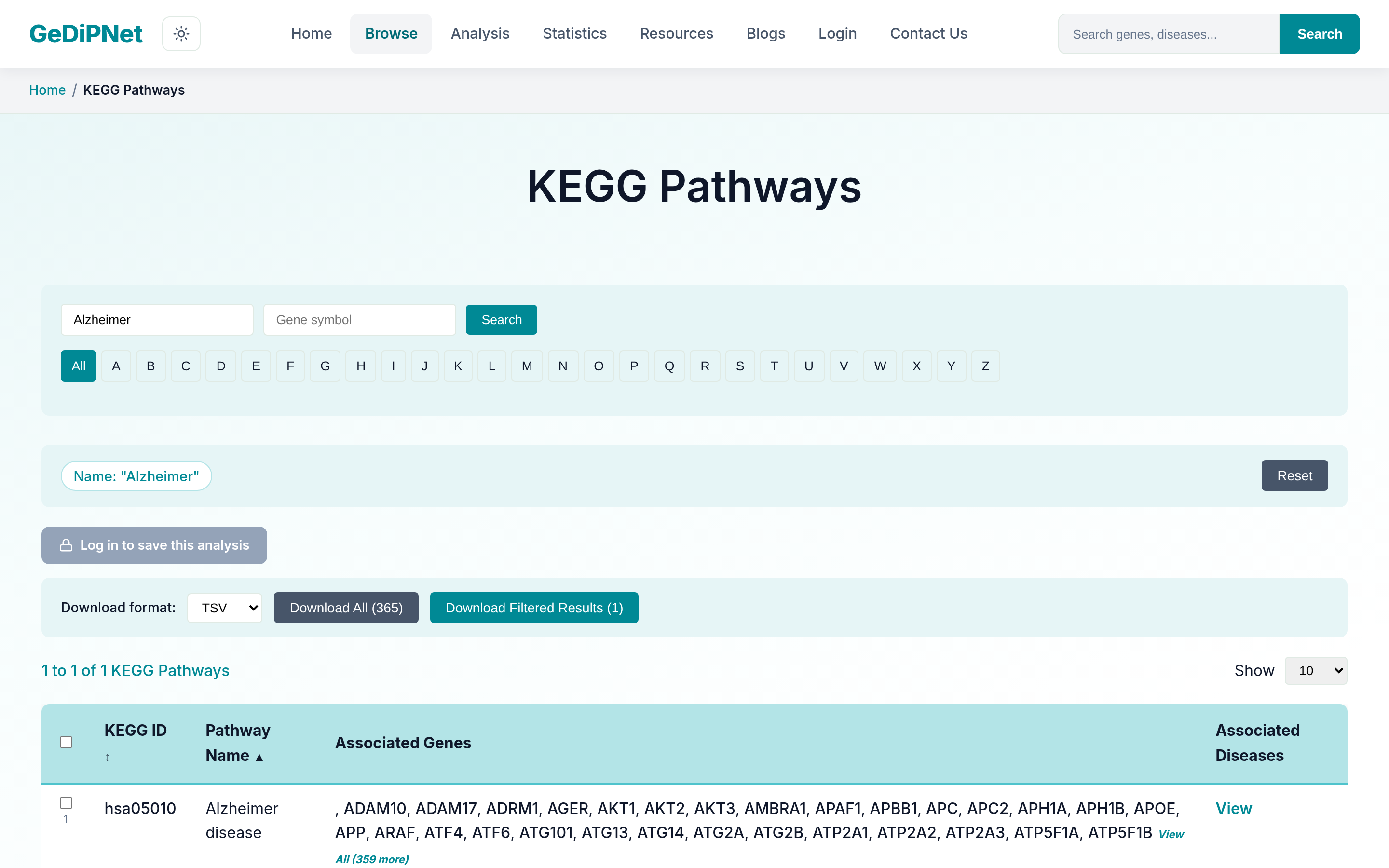
Browse Pathways: KEGG
Searching GeDiPNet's KEGG pathway browser for "Alzheimer" turns up KEGG pathway hsa05010, "Alzheimer disease" — and its gene list includes APOE. Insulin-receptor signaling isn't a diabetes side note here; as the next section shows, it's inside this same pathway.
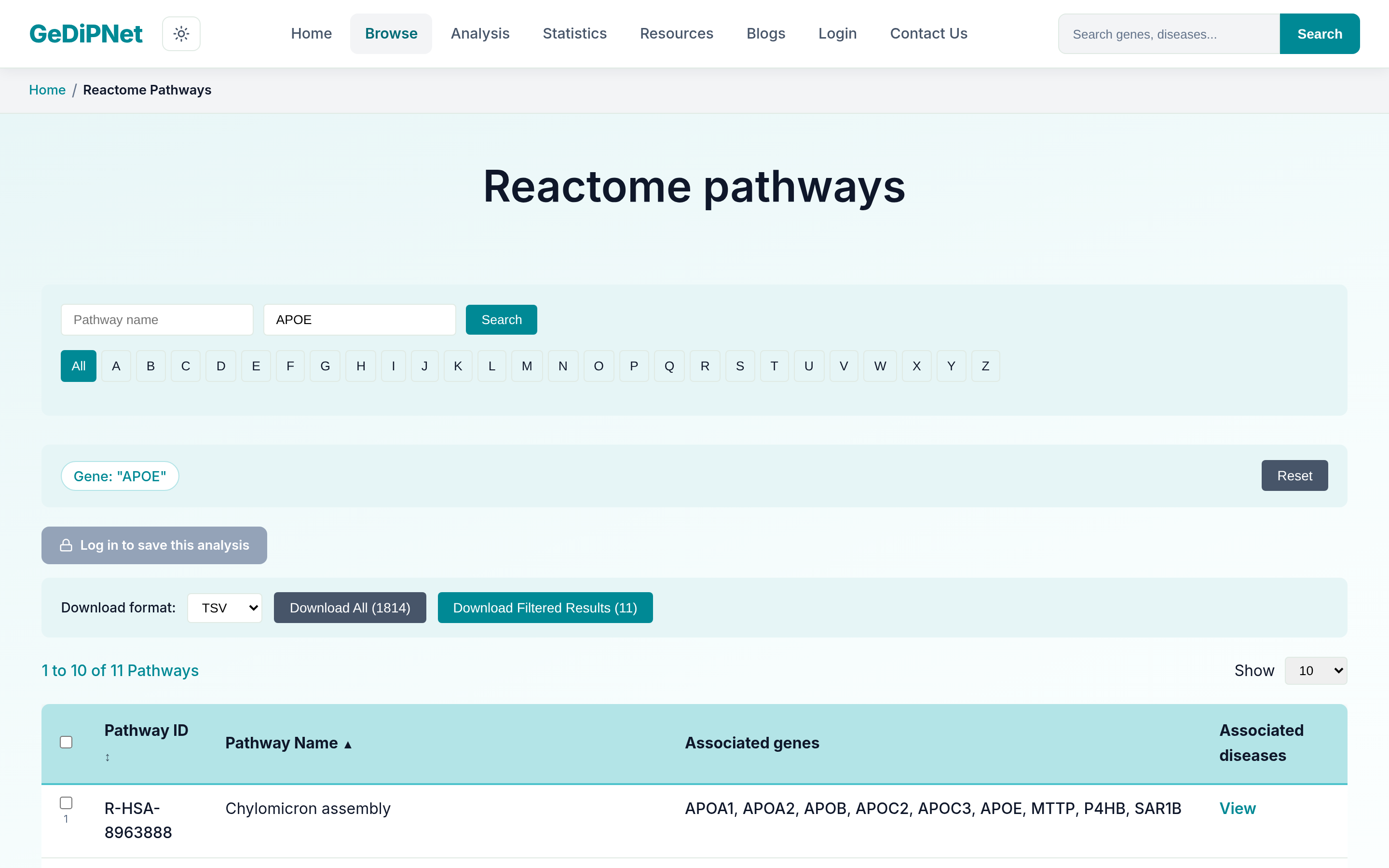
Browse Pathways: Reactome
Searching GeDiPNet's Reactome pathway browser for the gene APOE returns 11 real pathways — including "Chylomicron assembly," "Chylomicron clearance," and "Chylomicron remodeling" — the lipid-transport machinery APOE is best known for, independent of KEGG's disease-pathway view.
Enrichment analysis
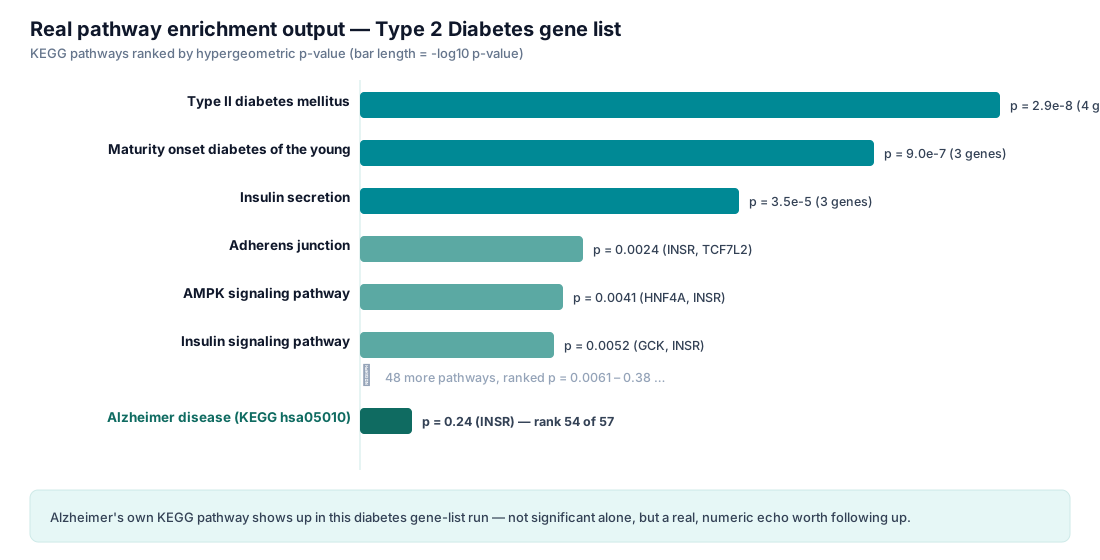
Browsing gives hints; Enrichment Analysis gives numbers. Pasting the top Type 2 Diabetes genes — TCF7L2, INSR, GCK, HNF1A, HNF4A, KCNJ11, ABCC8 — into Pathway Enrichment returns, among others: Insulin signaling pathway (GCK, INSR), AMPK signaling pathway (HNF4A, INSR), and Adherens junction (INSR, TCF7L2). Further down the ranked list, at position 54 of 57, is KEGG's own Alzheimer disease pathway (p = 0.24, matched via INSR) — on its own, not statistically significant, but a first real, numeric echo of what browsing already suggested.
Venn analysis
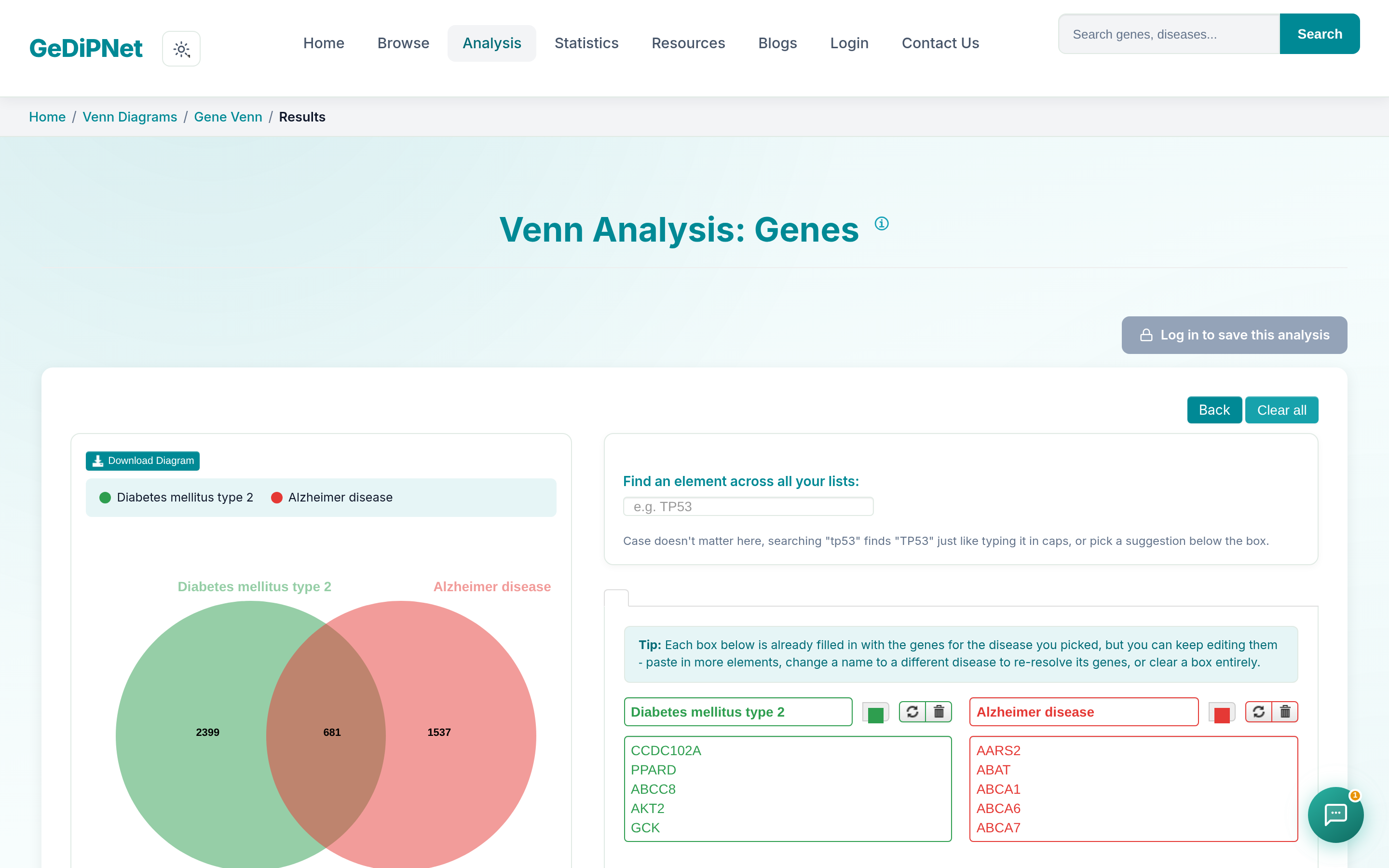
Enrichment tests one gene list against pathways; Venn analysis (Genes mode) compares two disease's gene sets directly. Entering "Diabetes mellitus type 2" and "Alzheimer disease" draws a real two-circle diagram: 2,399 genes unique to Type 2 Diabetes, 1,537 unique to Alzheimer's — and 681 genes shared between them, including APOE, TCF7L2, and INSR.
Comorbidity analysis
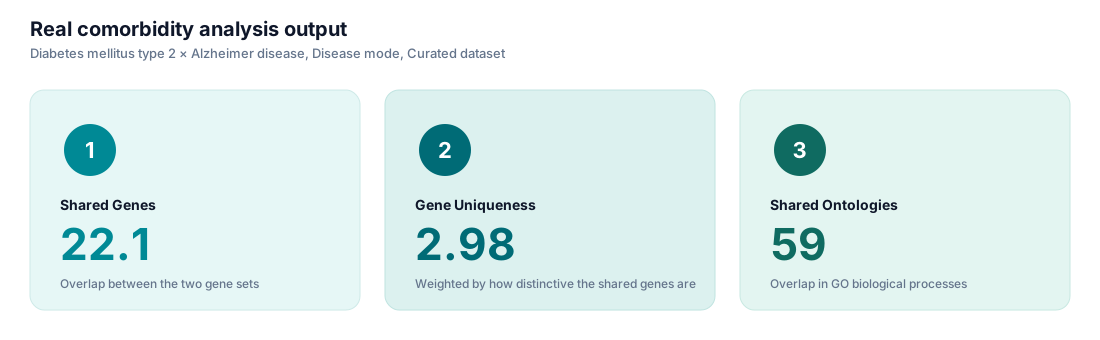
681 shared genes sounds like a lot, but both diseases have thousands of associations — so is it meaningful? Comorbidity Analysis turns that overlap into a comparable score. Selecting the same two diseases in Disease mode returns a Shared Genes score of 22.1, a Gene Uniqueness score of 2.98 (weighting the overlap by how distinctive those shared genes are), and a Shared Ontologies score of 59 — meaning the two diseases' genes also converge heavily on the same GO biological processes, not just the same gene symbols. (See our full comorbidity analysis guide for what each tab means.)
Polypharmacological target prediction
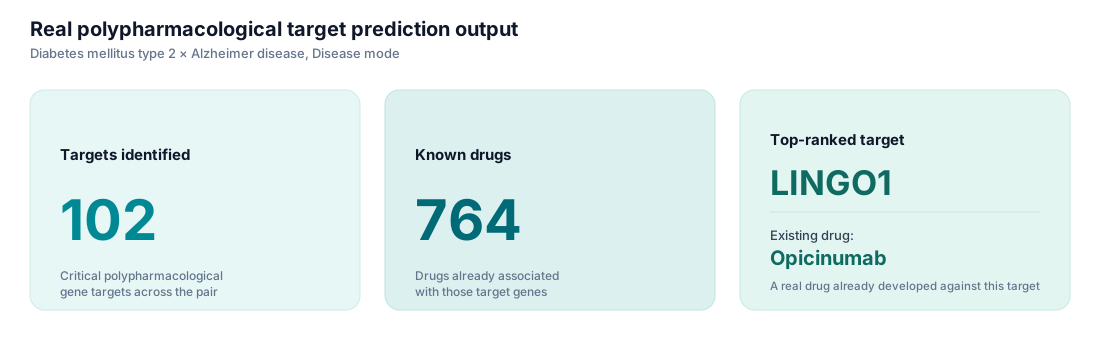
If two diseases are genuinely comorbid, the next question is whether one drug could address both. Running Polypharmacological Target Prediction on the same pair identifies 102 critical polypharmacological targets linked to 764 known drugs. The top-ranked target is LINGO1, with a real existing drug, Opicinumab, already developed against it — turning "these diseases are related" into an actual, named hypothesis worth investigating.
The answer
Yes — on GeDiPNet's own curated data, Type 2 Diabetes and Alzheimer's disease share a real, non-trivial genetic footprint. Browsing surfaces the first hint (APOE and TCF7L2 cross-listed; INSR sitting inside KEGG's own Alzheimer's pathway); enrichment analysis gives it a p-value; Venn analysis quantifies it at 681 shared genes; comorbidity analysis scores it directly (22.1 / 2.98 / 59 across three measures); and polypharmacological target prediction turns it into a concrete, named candidate — LINGO1 — with an existing drug already built against it. That's the loop: a question, answered with real numbers at every step, not just at the end.
For a deeper look at any single step, see Which GeDiPNet Analysis Tool Should I Use?, our comorbidity analysis guide, or just ask GeDiPNet's assistant about your own disease pair.